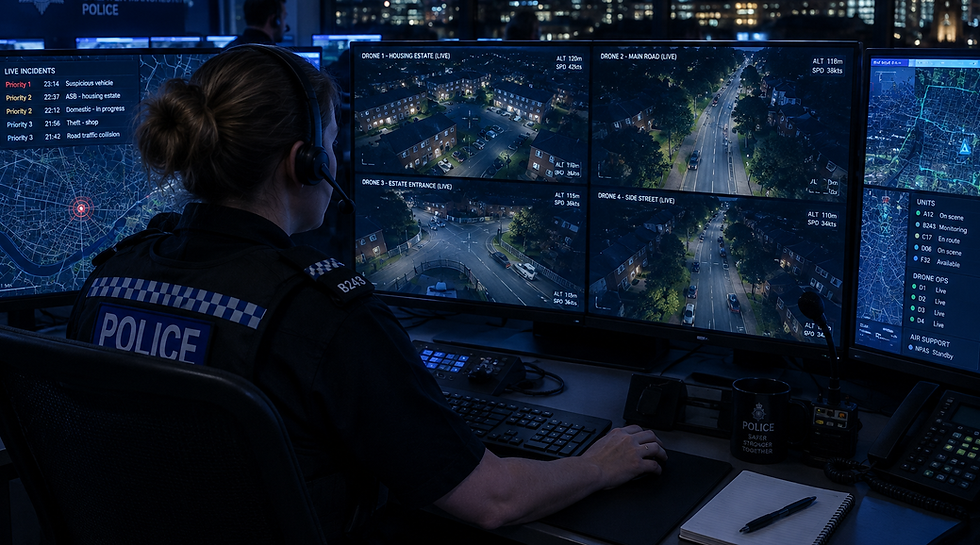
TV Policing Top Tropes: CCTV


CCTV is ubiquitous in the UK, and therefore one of the most useful tools in modern policing. But it’s also one of the most misrepresented on television. In drama, it’s too often shown as a magic solution: perfect colour footage, crystal-clear faces, and a detective who can “zoom in” or “enhance” a grainy image until it suddenly reveals every detail. In reality, CCTV is far more limited, far more mundane, and far less cinematic than that.
What TV gets wrong
Television loves the idea of CCTV as a high-tech surveillance tool. The operator sits in a dark room, clicks a few buttons, and suddenly the camera pans, zooms, and tracks the suspect in perfect detail. The detective then asks for facial recognition, and within minutes the system produces a name and a photograph.
That’s not how it works in practice. Most CCTV footage is grainy, often black and white, especially at night. The resolution is usually poor, and there is no magical “enhance” button. If you try to zoom in, you do not get more detail. You just get a bigger, blockier version of the same poor-quality image.
Doorbell cameras
One area where TV often misses a trick is doorbell cameras. In real investigations, these can be extremely useful because the quality is often better than a pole-mounted CCTV camera. But doorbell cameras typically have a very narrow view, capturing only a small slice of the action.
That means they are great for seeing who approached a specific door, but not for tracking someone across a wider area. In practice, officers often have to stitch together multiple doorbell cameras, shop CCTV, and transport footage to build a route. That is where the real work sits, not in one perfect camera angle.
What actually happens
In real investigations, CCTV is usually used in a much more practical way. The first job is to identify entry and exit routes from the scene of an incident. Then officers look for behaviour and activities before, during, and after the offence. They use the footage to build a timeline, identify potential witnesses, and sometimes eliminate suspects.
More often than not, CCTV is used to track an unknown offender to and from the scene of the crime, sometimes all the way to a place of work, a home address, or a transport hub. That is where the real value sits: not in perfect facial images, but in movement, routes, and associations.Think of it as a digital jigsaw puzzle, except most of the pieces are missing and the rest are just pictures of someone’s cat.
Facial recognition is not a magic wand
Facial recognition does exist, but it is not the instant, all-seeing tool that TV suggests. In the UK, police can make use of retrospective facial recognition, operator-initiated facial recognition, and live facial recognition. Live and retrospective facial recognition compares an image from CCTV against a database of custody photos – so the suspect has to be already in the police database.
Even then, the process is not automatic. A trained operator reviews potential matches, and the investigating officer then does additional checks before any identification is treated as reliable. It is a tool, not a shortcut, and it depends heavily on the quality of the original image.
How identification really works
In practice, if a detective is lucky enough to capture a facial image in enough detail to make it vaguely recognisable, the usual approach is much simpler. The image is circulated to other officers to see if anyone recognises the person. That may be through local knowledge, previous contact, or intelligence systems. It is not a high-tech instant match. It is often just an officer looking at a picture on the morning briefing, choking briefly on their tea, and saying, “I know who that is”.
That is one reason why good quality still images matter more than dramatic video sequences. A clear still can be circulated, shared, and used in appeals. A grainy video that cannot be enhanced is much less useful, no matter how dramatic it looks on screen.
Final thought
CCTV is a powerful investigative tool, but it is not the high-tech crystal ball that television often portrays. Most footage is limited, most systems cannot zoom or enhance, and facial recognition is not a routine instant fix. The real value of CCTV is in timelines, routes, and associations, not in perfect facial images.
If you want your police scenes to feel authentic, treat CCTV as it really is: useful, often frustrating, and rarely as dramatic as it looks on TV. I can help you get this right, while maintaining the drama!