
Drones are the new normal — and the pilot might be miles away

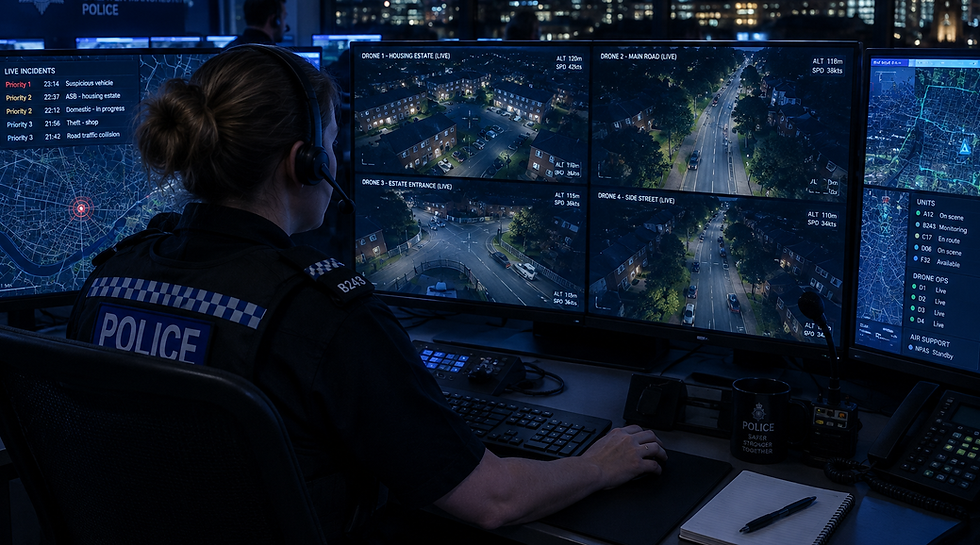
If you’re writing a contemporary UK police drama, there’s a quiet revolution happening that almost no one is putting on screen yet: police drones are now routine bits of kit, and the officer flying them might be miles away from the incident.
That simple shift, from “on-scene gadget” to “remote, networked capability”, is a fresh, underused hook for storytelling.
From novelty to everyday tool
Police forces across the UK already operate hundreds of drones. They’re used to find missing people, track suspects, and give commanders a live, overhead view of fast-moving incidents. Drones are part of the core air support mix, alongside helicopters, not as a one-off piece of kit.
In other words: if your story is set in the present day, it’s entirely credible for a force to have a small but active drone unit, with trained pilots and defined use-cases. And trials are ongoing for drones to be pre-located at take off sites spread across a police force area, ready to be remotely connected and piloted to an incident.
The pilot in the control room
The most interesting change for drama is where the pilot is actually located. Police forces are moving towards operations where the drone can fly well beyond the pilot’s direct line of sight, guided by technology and procedures rather than eyeballs on the sky.
The model being tested is “drone as first responder”: a drone dispatched immediately to an incident, arriving ahead of officers to give control rooms and commanders live eyes on the scene.
That means the officer controlling the drone could be:
In a regional control room, not at the incident.
Managing multiple drone feeds alongside other calls and resources.
Making rapid decisions about what the drone should look at next, while ground officers are still en route.
This is very different from what a viewer might imagine a police drone deployment to look like - an officer standing in a field, staring up at a drone. It’s more like air traffic control for policing: screens, headsets, live video walls, and a pilot who may never set foot at the scene.
Why this is a great hook for writers
This setup gives you several fresh storytelling opportunities that modern police dramas haven’t really explored:
Tension between remote and on-scene: The drone pilot sees everything from above but isn’t in physical danger; the ground team is exposed but reliant on the pilot’s view. That gap can create conflict, miscommunication, or moments of brilliant coordination.
New kinds of pressure: A pilot in a control room might be juggling multiple incidents, being told to “get eyes on” several locations at once, or asked to keep watching a suspect while other calls stack up.
Moral and ethical angles: Deciding what to zoom in on, what to record, and how long to follow someone raises questions about surveillance, privacy, and proportionality — perfect for character-driven drama.
Visual storytelling: Cutting between the drone’s cold, omniscient view and the messy, ground-level reality of officers and civilians gives you a strong visual language that feels contemporary and distinct.
A simple scene idea
Control receives a call about a disturbance in a housing estate. Instead of immediately committing multiple patrols, a duty officer authorises a drone launch. Minutes later, the drone is overhead, streaming live video back to a control room miles away. The pilot — an officer you’ve already introduced — scans the feed, spots a group dispersing down an alley, running from a prone form on the ground, and a spreading pool of blood. Does the controller track the suspects, or guide officers into what appears to be a seriously injured victim?
The drama isn’t in the gadget; it’s in the distance: the pilot seeing things no one on the ground can, making split-second choices that affect people they’ll never meet.
For realism on screen
To keep this credible:
Treat drones as integrated into command and control, not just handheld by an enthusiastic officer.
Show trained operators working under policies, with clear chains of authorisation.
Let the pilot be remote, possibly in a control room, managing live feeds and feeding information to ground teams.
Drones in UK policing are moving from experimental to embedded. Using the “remote pilot, miles from the action” angle gives you a modern, authentic, and largely untapped vein of police drama to mine.
Writing a script which shows police responding to incidents? Include drones – and give me a call, together we can make it dramatic and authentic!


